.png?width=1200&length=1200&name=YouTube%20-%20thumbnail%20(6).png)


1 min read
Microsoft Fabric: Overcoming Integration Challenges
Did you know that by 2025, global data creation is projected to grow to over 180 zettabytes? To put that in perspective, one zettabyte is equivalent...
5 min read
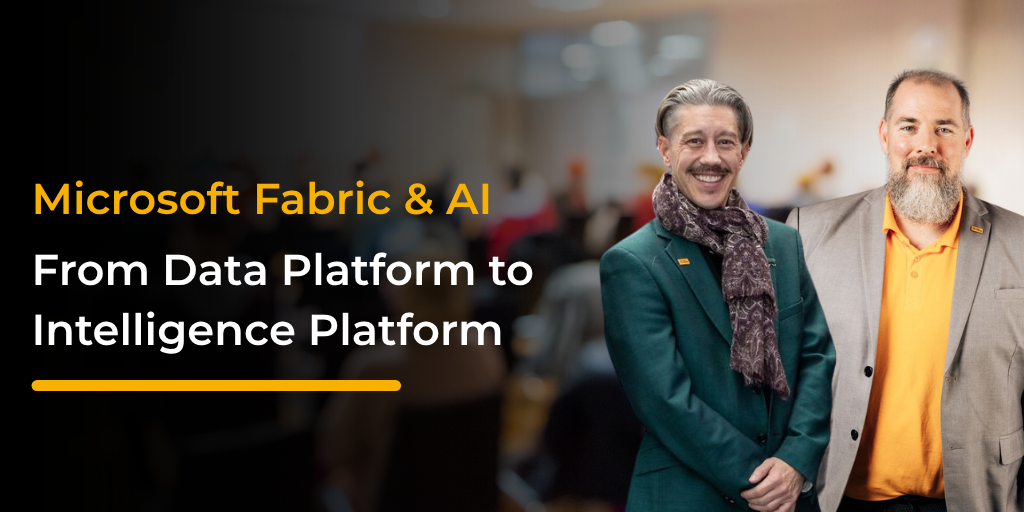
At FabCon Atlanta 2026, Microsoft didn’t just announce new Fabric features. It reframed how organizations are expected to interact with data and AI going forward.
In Part 1 of our Fabric & AI – 50 Takeaways from FabCon Atlanta 2026 series, we focus on what Microsoft calls the Intelligence Layer — and why it matters far more than any single feature release.
This post captures the key ideas from Part 1, explains why they matter in practice, and places them in the broader context of building an AI‑ready data platform with Microsoft Fabric.
One message came through clearly at FabCon:
Most organizations will not fail at AI because of models.
They will fail because their data is not usable, governed, or accessible.
Microsoft Fabric is evolving from a data platform into an intelligence platform — one where AI becomes the primary interface to enterprise data, not dashboards or reports.
This shift introduces a new architectural layer: The Intelligence Layer. It sits on top of:
OneLake
Semantic models
Security and governance
…and turns static data into secure, contextual answers that business users can act on.
The most visible expression of this shift is Fabric IQ. It enables a search‑everything experience across enterprise data:
Users can ask natural‑language questions
Answers are grounded in enterprise data
Responses respect existing permissions and security
Instead of asking “Where is the report?”, users can ask:
How did this customer perform last week?
Which product is underperforming?
What should I focus on selling next?
This marks the move from report‑driven analytics to question‑driven intelligence — a critical change for organizations trying to scale AI beyond analysts and data teams.
An important (and often underestimated) takeaway is:
AI does not replace governance — it amplifies it.
Fabric IQ inherits:
OneLake security
Existing permissions
Data access policies
That means well‑governed data enables safe AI at scale and that poor governance becomes immediately visible (and risky).
AI readiness is less about choosing the right copilot and more about establishing a trustworthy data foundation.
Another clear signal from FabCon 2026 was that AI is no longer positioned as a separate assistant sitting alongside existing systems. Instead, it is becoming an operator inside everyday workflows.
Microsoft showed how AI capabilities can now be authored once and reused across the platform, invoked directly from development environments such as VS Code, and embedded into Fabric processes themselves. AI agents are no longer limited to answering questions — they can deploy, update, enrich, and maintain Fabric assets as part of normal operations.
The practical impact of this shift is significant. Tasks that were previously manual or semi‑automated can now be handled systematically: generating and maintaining product descriptions, enriching data models at scale, or embedding AI logic directly into pipelines and applications. In effect, AI moves from helping humans do work to executing work within enterprise systems.
One of the most pragmatic takeaways from Part 1 was the focus on multimodal AI pipelines.
Microsoft Fabric now makes it possible to handle documents, PDFs, invoices, and even images within a single, orchestrated workflow. Different AI actions can be applied at different stages of the pipeline — extracting information, validating it, enriching it, and then making it available for analytics or downstream applications.
This directly addresses everyday enterprise challenges such as manual invoice processing, unstructured document handling, and image‑based analysis in industries like construction or logistics. For many organizations, these scenarios represent the point where AI stops being experimental and begins delivering measurable operational value.
Microsoft Fabric is emerging as the system that grounds those AI interactions in trusted, governed information. And success increasingly depends on governance, semantics, and architecture rather than isolated AI features.
This is why treating Microsoft Fabric as “just another analytics tool” misses the bigger picture. Real value from Fabric and AI comes from building a unified data architecture, establishing strong governance foundations, and aligning business questions with data models and AI capabilities.
That is where deep experience with data platforms, AI, and real‑world implementations becomes essential.
This article is based on Part 1 of our Fabric & AI – 50 Takeaways from FabCon Atlanta 2026 series, recorded by Ryan Paterson and Tristan Threlkeld from Data Courage.
In the next parts of the series, we move into data integration, connectivity, and what this shift means for real‑world architectures including Dynamics 365 Business Central and other enterprise systems.
If you’re exploring how to build an AI‑ready data platform on Microsoft Fabric, we’ll be happy to help you make sense of what changed and how to apply it in practice.

FAQ: Microsoft Fabric, Data & AI
Microsoft Fabric is a unified data and analytics platform that brings together data integration, engineering, governance, analytics, and AI in a single environment. Its purpose is not just to store or report on data, but to make enterprise data usable, secure, and ready for AI‑driven decision‑making.
As discussed in FabCon 2026, Fabric is increasingly positioned as the foundation for enterprise intelligence, not just a BI or analytics tool.
The Intelligence Layer is the concept introduced to describe how AI sits on top of governed enterprise data in Microsoft Fabric.
Instead of users navigating dashboards or datasets, AI becomes the interface:
Users ask questions in natural language
AI answers using trusted enterprise data
Existing security and permissions are enforced automatically
This shift is central to how Fabric enables AI at scale.
Fabric IQ is Microsoft’s intelligence capability within Fabric that enables natural‑language interaction with enterprise data. It allows organizations to:
Search and query data across Fabric
Receive contextual, explainable answers
Ensure responses respect OneLake security and governance
Fabric IQ is a key step in moving from report‑based analytics to question‑led intelligence.
Fabric supports AI by providing:
A unified data foundation (OneLake)
Semantic models grounded in business context
Built‑in governance and security
AI functions and agents embedded directly into workflows
Rather than layering AI on top of fragmented systems, Fabric makes AI part of the data platform itself — which is why data readiness and architecture matter so much.
AI amplifies whatever data environment already exists. In Microsoft Fabric:
Strong governance enables safe AI adoption
Weak governance becomes immediately visible through AI responses
As highlighted in Part 1 of the series, AI readiness depends less on models and more on data structure, access control, and trust.
Multimodal AI pipelines allow Fabric to process different types of inputs — such as:
Within a single workflow, AI can:
This is one of the fastest paths to real AI ROI in many organizations.
Microsoft Fabric can integrate Business Central data into a centralized data platform where it can be:
Modeled consistently
Governed securely
Used for AI, analytics, and cross‑system insights
This enables scenarios such as:
AI‑driven financial analysis
Natural‑language queries over ERP data
Combining Business Central data with other enterprise sources
Fabric acts as the intelligence backbone, with Business Central as a key system of record.
Before focusing on AI features, organizations should ensure:
This is why Microsoft Fabric implementation is as much a data and architecture exercise as it is a technical one.
Successful Fabric and AI initiatives typically involve:
Business leaders defining key decisions and questions
Data and AI experts designing the platform
Strong alignment between architecture, governance, and outcomes
Treating Fabric purely as an IT tool limits its value. Treating it as a business intelligence platform unlocks it.


1 min read
Did you know that by 2025, global data creation is projected to grow to over 180 zettabytes? To put that in perspective, one zettabyte is equivalent...
1 min read
You sat through the Power BI implementation. The dashboards look good. Data refreshes overnight, and nobody emails a workbook called Sales_FINAL_v7...
1 min read
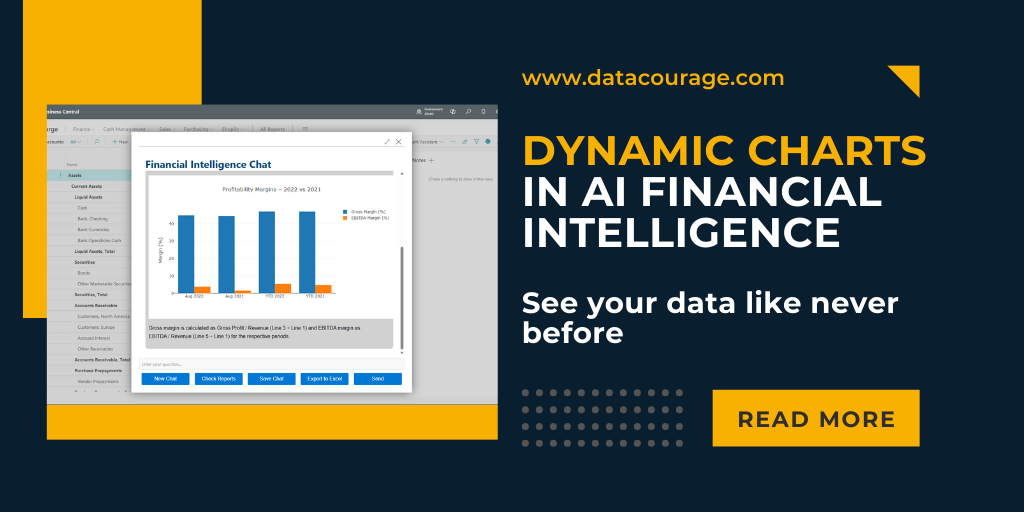
Every number in your business reveals something. It may signal a trend, expose a risk, or show where growth is happening. When that data hides in...
