
1 min read
What Most Companies Miss When Setting Up AI for Their Financial Teams
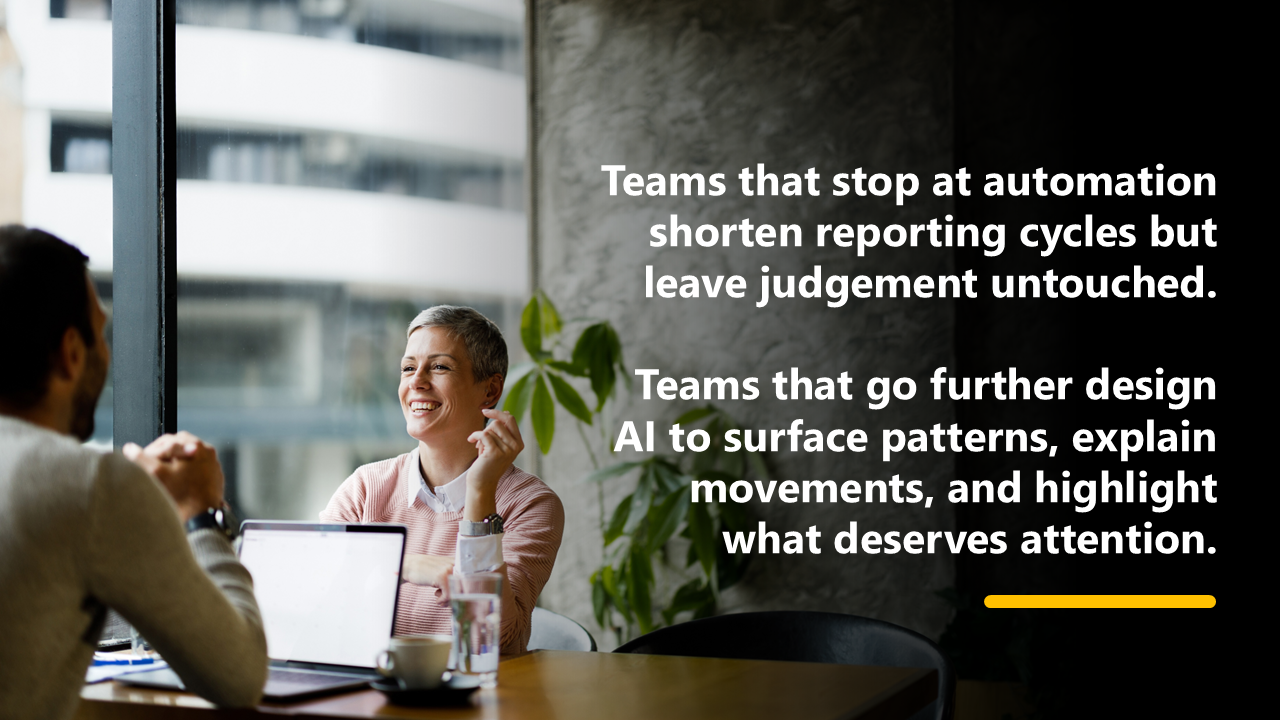
Finance leaders don’t struggle to understand why AI has become part of the conversation. What slows progress is what happens after the initial...
4 min read

For many finance teams, the financial close remains one of the most demanding and least forgiving parts of their work. Despite years of investing into tools to help with efficiency, for most, period-end still means long hours, manual workflows, and pressure to deliver results.
At the same time, the role of finance is evolving. CFOs and controllers are no longer judged solely on whether the books close on time. They are expected to provide insight, explain performance drivers, anticipate risks, and support better decisions across the business. This shift has exposed a growing gap between what traditional ERP systems were designed to do and what modern finance teams actually need.
This is where artificial intelligence, embedded directly within ERP, is beginning to change the financial close in meaningful and practical ways. Not as a futuristic concept, but as a set of tools that reduce manual effort, strengthen controls, and surface insight from data that already exists inside the system.
Most ERP systems are highly effective at recording transactions. They are far less effective at helping finance teams understand what those transactions mean, whether they are complete, or where attention should be focused before close deadlines arrive. As a result, many organisations develop and rely on layers of workarounds - data is exported into spreadsheets for validation, checklists live in documents or project tools disconnected from the ledger, and teams scramble to explain variances after they discover them through manual processes.
These approaches persist not because finance teams prefer them, but because they have historically been the only option. The consequence is a close process that is slower than it needs to be, more fragile than it should be, and heavily dependent on individual knowledge rather than consistent system logic.
As organisations grow in complexity, these limitations become more visible. More entities, more currencies, more regulatory scrutiny, and more demand for timely insight all increase the strain on finance teams. Simply asking people to work harder or longer is not a sustainable solution.

The most important shift AI brings to the financial close is not automation alone, it is context. When AI operates directly within an ERP such as Microsoft Dynamics 365 Business Central, it has access to real-time financial data including the chart of accounts, company structure, posting logic, and historical patterns. This allows intelligence to be applied where and when the work happens rather than after the fact.
Instead of relying on static reports or manual analysis, finance teams can ask questions of their data in natural language and receive clear, structured answers based on live ledger information. Instead of running through checklists line by line, they can define control expectations once and allow the system to evaluate them consistently every period.
One of the most persistent challenges in the close is not producing numbers, but explaining them. Variance analysis often begins after the books are closed, which means insight arrives too late to influence decisions. AI driven financial intelligence changes this dynamic by allowing teams to explore drivers of performance while the work is still in progress.
When a finance professional can ask why revenue shifted in a particular region, or which cost categories are driving margin changes, and receive an immediate response supported by visual context, the conversation moves from reporting to understanding. This capability reduces reliance on offline analysis and helps ensure that leadership discussions are based on consistent data.
Importantly, this is not about replacing professional judgement. It is about giving finance teams better tools to apply that judgement more efficiently and with greater confidence.
Another area where AI is having a significant impact is governance and control. Many close activities exist solely to prove that something has been checked. These checks are often repetitive, time consuming, and vulnerable to human error, especially under deadline pressure.
The AI Chief Accountant Assistant from Data Courage addresses this challenge by allowing organisations to define control scenarios in plain language and automatically validate them against Business Central data. Instead of manually confirming that accounts reconcile or that posting rules have been followed, finance teams can rely on consistent system driven validation that produces clear outcomes and explanations.
Over time, this also supports a shift toward continuous close practices, where validation happens throughout the period rather than being compressed into a few intense days at month end.

Not every organisation is at the same stage of maturity, and there is no single approach that fits all. Successfully transforming the financial close with AI starts with understanding the current state and being clear about objectives.
The first step is an honest assessment of how the close operates today. This includes the length of the close cycle, the volume of manual adjustments, the degree of spreadsheet dependency, and the level of confidence in reported numbers. Understanding where time and effort are being spent provides a foundation for identifying where AI can deliver the most value.
From there, organisations should define what they want to improve. For some, the priority may be reducing close time. For others, it may be improving audit outcomes or freeing capacity for analysis. Clear goals help avoid technology decisions driven by features rather than outcomes.
When assessing ERP and AI capabilities, several metrics are particularly useful. These include the reduction in manual close activities, improvements in reconciliation accuracy, consistency of control execution, and the speed at which finance teams can answer questions from leadership. User adoption is equally important, since tools that are difficult to use or operate outside the core ERP often fail to deliver sustained value.
Technology alone does not transform the close. Sustainable change comes from combining the right tools with the right expertise. This is where a partner like Data Courage plays a critical role.
By focusing specifically on financial intelligence within Microsoft Dynamics 365 Business Central, Data Courage works closely with customers and implementation partners to ensure that AI capabilities address real operational challenges. The emphasis is on practical outcomes, such as faster closes, stronger controls, and better insight, rather than abstract innovation.
Long term support is particularly important as finance requirements evolve. Regulatory changes, organisational growth, and new reporting demands all require systems that can adapt. A partner that remains engaged beyond initial deployment helps ensure that AI continues to deliver value as the business changes.
As AI becomes more embedded in ERP systems, the financial close is shifting from a periodic burden to an integrated, intelligent process. Finance teams gain visibility earlier, confidence improves, and conversations with leadership become more meaningful.
This transformation does not happen overnight, and it does not require a complete overhaul of existing systems. It begins with targeted improvements that reduce friction and build trust in the numbers. Over time, these improvements compound, allowing finance to focus less on mechanics and more on insight.
The organisations that succeed will be those that treat AI not as a separate initiative, but as a natural extension of their ERP strategy. By embedding intelligence where financial data already lives, they create a foundation for faster closes, stronger governance, and more informed decision making.

1 min read
Finance leaders don’t struggle to understand why AI has become part of the conversation. What slows progress is what happens after the initial...

1 min read
Closing the books at month-end shouldn't feel like running a marathon. Yet for many finance teams using Microsoft Dynamics 365 Business Central, the...
1 min read
If you're running Microsoft Dynamics 365 Business Central and still exporting data to build monthly reports, you're working harder than you need to.
